
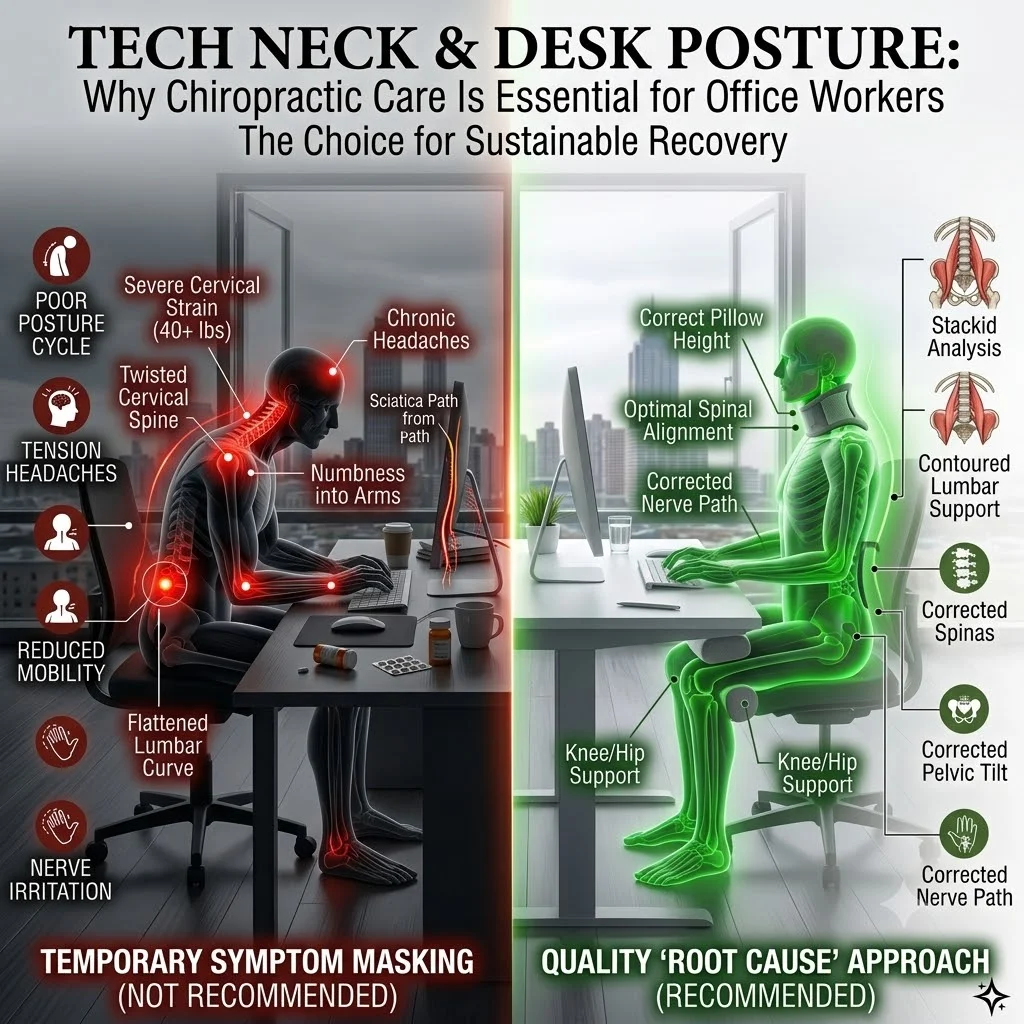
If you spend most of your day at a desk, in meetings, or scrolling on your phone between tasks, there’s a good chance your spine is paying the price. It’s not just “sitting too much” — it’s a specific, measurable strain called tech neck, and it’s one of the most common issues we see at Well Adjusted Buckhead among Atlanta’s office workers, remote professionals, and anyone glued to a screen for hours at a time.
The good news? Tech neck is preventable and treatable. Here’s what’s actually happening to your body, the warning signs to watch for, and how chiropractic care can help you undo the damage.
What Is Tech Neck?
Tech neck happens when your head consistently juts forward — think of the posture you fall into when you’re looking down at a laptop, phone, or monitor that isn’t at eye level. It seems harmless in the moment, but your neck wasn’t built to hold that position for hours on end.
Here’s the part most people don’t realize: for every inch your head moves forward from its neutral position over your shoulders, the effective weight your neck and upper back muscles have to support roughly doubles. A head that normally weighs about 10-12 pounds can feel like it’s putting 20, 30, even 40+ pounds of strain on your cervical spine when it’s tilted forward for long stretches. Multiply that by an 8-hour workday, five days a week, and it’s easy to see why so many desk workers end up dealing with chronic neck and upper back pain.
Symptoms to Watch For
Tech neck doesn’t always show up as obvious neck pain right away. It often creeps in through:
- Frequent tension headaches, especially by mid-afternoon
- Tightness or aching across the shoulders and upper back
- A stiff neck that feels worse first thing in the morning
- Numbness or tingling radiating into the arms or hands
- A noticeable forward “hunch” when you catch your reflection or a photo
If any of this sounds familiar, it’s worth paying attention — these are often early signals that your body is compensating for a posture problem, not just having an “off day.” We cover more of these warning signs in Signs You Need a Chiropractic Adjustment: Headaches, Poor Posture, and More, if you want a fuller picture of what your body might be telling you.
Why It’s More Than a Posture Problem
It’s tempting to think of tech neck as a cosmetic issue — something that just makes you look a little hunched. In reality, the effects go much deeper.
Sustained forward head posture puts continuous pressure on the discs and joints of your cervical spine. Over time, this can lead to:
- Reduced neck mobility and stiffness that lingers even outside of work hours
- Nerve irritation or compression, which is often what causes tingling or numbness in the arms
- Accelerated wear on the cervical discs and joints, which can contribute to more serious spinal issues down the road
- A ripple effect on the rest of your spine, since your body naturally compensates by shifting posture elsewhere — often in the mid and lower back
Left unaddressed, what starts as an achy neck at your desk can gradually turn into a much bigger, harder-to-reverse problem.
How Chiropractic Care Helps
This is exactly the kind of issue chiropractic care is built to address — not by masking the pain, but by correcting the underlying mechanics that are causing it.
At Well Adjusted Buckhead, treatment for tech neck typically includes a combination of:
- Spinal adjustments to restore proper alignment and relieve pressure on irritated nerves and joints
- Soft tissue therapy to release the chronically tight muscles in the neck, shoulders, and upper back that develop from prolonged forward posture
- Postural retraining and targeted exercises to help you rebuild the strength and awareness needed to hold better posture throughout the day, not just during your appointment
You can learn more about our approach on our Chiropractic Care and Soft Tissue Therapies pages.
Simple Desk Fixes You Can Start Today
While professional care addresses the root of the problem, there’s a lot you can do at your desk right now to reduce the daily strain:
- Raise your monitor so the top of the screen is at or just below eye level — you shouldn’t be tilting your chin down to read it.
- Bring your phone up to eye level instead of looking down at it, especially during longer calls or scrolling sessions.
- Set a movement reminder every 30-45 minutes to stand, roll your shoulders back, and gently stretch your neck side to side.
- Check your chair and desk height — your elbows should rest comfortably at roughly a 90-degree angle, with your feet flat on the floor.
- Do a daily “reset” stretch: gently tuck your chin, draw your shoulder blades back and down, and hold for 10-15 seconds a few times a day.
These small habits won’t undo months or years of strain on their own, but they go a long way in slowing the damage while you work on correcting it at the source.
Don’t Wait for the Pain to Get Worse
Tech neck is one of those issues that’s easy to ignore until it isn’t — until the headaches become daily, or the tingling in your arm starts interrupting your sleep. The earlier you address it, the easier it is to correct.
If you’re spending your days at a desk and dealing with neck pain, headaches, or that all-too-familiar hunch, we’d love to help you get back to feeling — and standing — taller.