
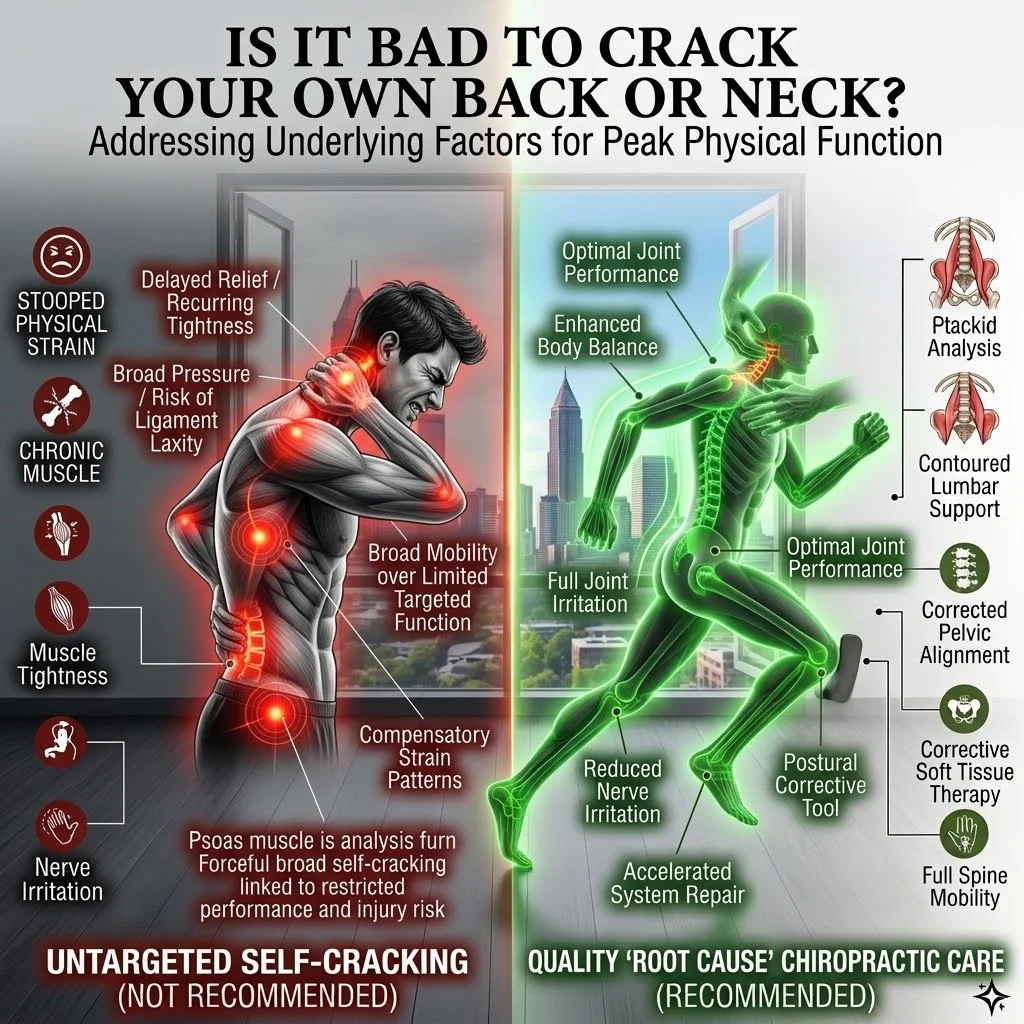
If you’ve ever twisted your torso to get that satisfying pop, or tilted your head side to side until your neck cracks, you’re far from alone. Self-cracking is one of those habits almost everyone does at some point — sometimes without even thinking about it. But is it actually bad for you? Here’s what’s really happening when you crack your own back or neck, and when it’s worth taking more seriously.
What Actually Happens When You Crack a Joint
That popping sound isn’t your bones grinding together, and it isn’t your joints “moving back into place.” It’s mostly gas.
Your joints are surrounded by a lubricating fluid called synovial fluid, which contains dissolved gases like oxygen, nitrogen, and carbon dioxide. When you stretch or twist a joint beyond its normal range, the joint capsule expands, and this rapid change in pressure causes tiny gas bubbles in the fluid to collapse or release. That collapse is what creates the cracking or popping sound — a process known as cavitation.
In other words, cracking your back or neck occasionally isn’t inherently dangerous. It’s a normal physical process, not damage happening in real time.
So Why Does It Feel So Satisfying?
Cracking a joint often triggers an immediate feeling of relief or looser movement, and there’s a real reason for that. The stretching involved in a self-crack can temporarily stimulate nerve receptors around the joint, which may reduce the sensation of stiffness or tightness for a short period. It can also trigger a small release of tension in the surrounding muscles.
The catch is that this relief is usually temporary — and that’s where the habit of constant self-cracking can start to become a problem.
When Self-Cracking Becomes a Concern
Occasional cracking isn’t something to worry about. But there are a few patterns worth paying attention to:
You feel like you need to crack the same spot constantly. If you’re cracking your neck or back multiple times a day just to feel “normal,” that’s often a sign of an underlying issue — not something the cracking itself is fixing. Frequently needing to self-crack can indicate joint instability, muscle tension, or a spinal misalignment that keeps building pressure back up shortly after you crack it.
The relief doesn’t last very long. If you’re back to feeling stiff or “needing” to crack again within minutes or hours, the self-cracking isn’t addressing the actual cause — it’s just temporarily masking it.
You’re forcing the movement. Gently rotating or stretching into a natural crack is very different from aggressively twisting, pulling, or having someone else forcefully manipulate your neck or back. Forceful, uncontrolled movements — especially in the neck — carry real risk of straining muscles, ligaments, or in rare cases, affecting blood vessels or nerves in that area.
You’re cracking to relieve actual pain, not just stiffness. If you’re self-cracking because you’re in pain, rather than to relieve minor tightness, that’s a signal your body is asking for more than a quick pop can provide.
Can Cracking Your Own Back or Neck Cause Damage?
For most people, occasional, gentle self-cracking isn’t going to cause harm. However, there are a few reasons professionals generally recommend against making it a frequent habit:
- It doesn’t address the root cause. Self-cracking can feel like relief, but it doesn’t correct the misalignment, muscle imbalance, or restriction that’s causing the stiffness in the first place.
- It can mask a bigger problem. Relying on frequent self-cracking may delay you from noticing or addressing a more serious underlying issue, like a disc problem or chronic postural misalignment.
- Aggressive or forceful cracking carries more risk. Especially in the neck, uncontrolled or forceful movements can strain soft tissue or, in rare cases, lead to more serious complications. This is very different from a controlled, precise chiropractic adjustment.
How This Is Different From a Chiropractic Adjustment
It’s a common misconception that a chiropractic adjustment is just a more official version of self-cracking. In reality, the two are quite different.
When you crack your own back or neck, you’re generally moving the joint in a broad, imprecise way — you’re not targeting a specific segment of the spine, and you don’t have a full picture of which joints are actually restricted versus which ones are simply mobile and “along for the ride.”
A chiropractic adjustment, on the other hand, is a controlled, targeted movement applied to a specific joint that’s been evaluated for restriction or misalignment. Rather than randomly cracking whatever joint is easiest to reach, a chiropractor identifies exactly where the restriction is and applies a precise adjustment to correct it — addressing the actual cause of the stiffness, rather than just producing a satisfying sound.
When to See a Chiropractor Instead of Self-Cracking
If you notice yourself reaching for that self-crack multiple times a day, if the relief never seems to last, or if you’re dealing with actual pain rather than mild stiffness, it’s worth having your spine properly evaluated rather than continuing to self-manage it.
A chiropractic evaluation can identify what’s actually causing the tension or restriction you’re feeling — whether that’s postural strain, a specific joint misalignment, or muscle imbalance — and address it directly, rather than leaving you dependent on cracking the same spot over and over.
The Bottom Line
Cracking your own back or neck every once in a while isn’t something to be alarmed about — it’s a normal, mostly harmless process. But if it’s becoming a frequent habit, if the relief is short-lived, or if you’re doing it to manage real pain, that’s your body telling you there’s something underneath it worth addressing.